
 Introduction to Physics

Click on the menu on the left to change the font of the text to your liking.
Click on the day and night icon to darken the background of the text.
📚 Introduction to Physics
(in simple terms)

2- 🎯 Take the Practice Quiz( Test your understanding )
What You'll Learn
- What is Physics? What Are Its Applications?
- What are the branches of physics?
- Application of Physics in Medicine and Health
- Application of physics in the field of optical devices
- Application of physics in communications
- How is the scientific method used in physics?
- Law, Principle, theory, hypothesis
📖 1 - What is Physics? What Are Its Applications?

In simple terms, physics is the science of measurement and understanding the natural world. The word itself comes from the Greek "physis," meaning nature. Its goal is to comprehend the universe and its laws. We've just mentioned two key concepts: measurement and laws. Essentially, we first use appropriate tools to make necessary measurements. Then, based on these measurements and other observations, we discover the laws governing the universe.
Before diving deeper, let's clarify some fundamental concepts:
Phenomenon (or Event): Anything that happens is a phenomenon. A solar eclipse is a phenomenon. A leaf falling from a tree is also a phenomenon.
Knowledge: The entire body of information that humanity has about the universe and uses in daily life. Note that knowledge is much broader than science.
Science: A subset of knowledge that primarily deals with the facts of nature. Knowledge includes other domains, like philosophy and art, which science does not address.
Technology: Science makes discoveries, and technology strives to implement them in everyday life. In other words, technology involves applying scientific laws and discoveries through engineering and industry. For example, physics examines electromagnetic waves and discovers their scientific principles. Technology then uses these principles to create devices like mobile phones, radios, and televisions. Technology draws from both science and other fields of knowledge, such as using art for product design.
📖 2 - What are the branches of physics?
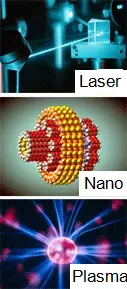
First, it is necessary to mention the role of mathematics. Although all sciences are related, mathematics plays a fundamental role in physics. Mathematics solves problems with the help of appropriate formulas. Sometimes it uses diagrams. Sometimes it presents complex theories to explain unknown worlds. Mathematics is an integral part of physics.
- Physics studies a wide range of fields from very small atoms to stars and galaxies. Areas that Physics Studies: atomic and molecular physics, solid state, condensed matter, plasma, nuclear, elementary particle and field theory, astronomy and astrophysics, optics and lasers, nanophysics, medical radiation, health, and the environment, etc. can be mentioned.
- In addition, many important concepts are discussed in physics. Concepts that Physics Studies: motion, force, energy, work, heat, electricity, magnetism, atom, etc., are studied in detail and scientifically.
- The oldest branch of physics is astronomy. This branch has its own beauty. Astronomers in early human civilizations carefully studied the night sky. At that time, astronomers used primitive astronomical instruments, such as the astrolabe. The invention of the telescope brought about a major revolution in the field and ushered in a new era of astronomy. We will study astronomy in another section
Below are some of the uses of physics in Life.
📖 3 - Application of Physics in Medicine and Health
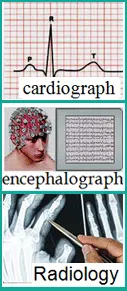
- Electrocardiograph: Used to diagnose heart diseases.
- Electroencephalograph (encephalography): Used to diagnose diseases related to the brain.
- Sonography: With the help of ultrasound waves, images of parts of the human body can be prepared.
- Radiology: The use of X-rays to take pictures of parts of the body. For example, radiology is used to take pictures of broken bones.
📖 4 - Application of physics in the field of optical devices
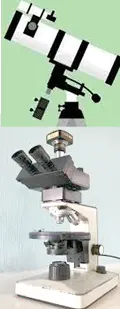
- Telescope: You can see very distant objects. The use of lenses and mirrors, visible light, and electrons in a microscope demonstrates the applications of physics in this device.
- microscope: You can see very small objects. This device uses visible light and electromagnetic waves, which are in the field of physics.
- Video camera: With the help of light that reaches the camera from the environment (similar to the eye), you can record videos.
📖 5 - Application of physics in communications

- Mobile phone: The use of electromagnetic waves in mobile phones is a clear example.. This has become very common and widespread.
- Radar: With the help of radio waves, the location of objects can be detected. This is especially used in military matters.
The application of physics is very wide. What was mentioned above describes a very small part.
📖 6 - How is the scientific method used in physics?
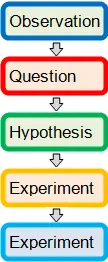
In scientific disciplines, a specific method is used that allows us to obtain more accurate results. This method is called scientific method. The scientific method is very useful and fundamental in scientific subjects. We tried to choose examples from physics. You can even apply this method in your daily life. These steps have allowed scientists to gain a more accurate understanding of the universe with the help of mathematics.
The steps of the scientific method are as follows:
- Observation: It is achieved through the senses or with the help of appropriate tools. For example, when you look at the path of light propagation, you see that its path is a straight line. Note: Observation is not only through sight, but other senses are also used in observation. For example, hearing the sound of a collision is also considered observation. Today, physics uses complex and advanced tools. This is also considered observation.
- Problem formulation: At this stage, we ask an appropriate question about what we observed. Is the path of light always a straight line?
- Presenting a hypothesis: At this stage, we guess an answer. Note that the hypothesis may be true or false. We say that light propagates in a straight line under all conditions. There are many hypotheses in physics that have not yet been definitively confirmed.
- Experiment: At this stage, we conduct various experiments. If the hypothesis is confirmed, it becomes a theory, otherwise we must modify it. For example, when we experiment, we see that light propagates in a straight path in air. This result is also true in water. That is, light propagates in a straight path in water. But when we shine light from air to water, we observe that its path is a broken line.
- Conclusion: At this stage, if our guess is confirmed with the help of the experiment, we can draw a conclusion; that is, our hypothesis becomes a theory. Here we conclude: light propagates in a straight line in a uniform and uniform medium.
📖 7 - Law, Principle, theory, hypothesis
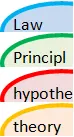
The following terms are used a lot in various sciences, especially in physics; pay attention and learn their difference.
Law: Expresses a general fact that covers a wide area. Like Newton's law of gravity, it covers the entire universe.
Principle: Similar to a law but expresses a fact that covers a limited area. Like Pascal's principle, which is about the pressure of liquids.
Difference between principle and law: Both express a fact, but a law covers a wide area. Meanwhile, there is no clear boundary between principle and law.
Difference between law and theory: A law only states reality but does not pay attention to its cause and effect. But a theory also pays attention to its cause. For example, the law of gravity states that all objects that have mass attract each other. But the theory of gravity in physics also refers to the cause and effect of this issue. In fact, a theory should answer this question: Why do objects attract each other?
Difference between hypothesis and theory: A theory is a confirmed hypothesis. In other words, a hypothesis is a conjectural and hypothetical answer that has not yet been confirmed by an experiment. When an experiment confirms a hypothesis, it becomes a theory.
📝 Practice Quiz
physics
Frequently Asked Questions
📌 What is physics and what is its importance in life?
It is the science of measuring and understanding the universe. It plays a very important role in the fields of health and medicine, technology, air and space, communications...📌 What is a principle, law, theory, and hypothesis?
All these concepts express facts about the universe.They have similarities and differences that are fully mentioned in the lesson text.📌 What is the scientific method and what are its steps?
It is a specific method for discovering facts about the world around us and has the steps: observation, questioning, experiment, hypothesis, and conclusion.We Value Your Feedback
If you're satisfied with our service, a high rating would truly encourage our team. If you have concerns, we'd appreciate hearing your specific reasons in the comments so we can address them directly.
Number of votes = 1
Average rating 5 out 5
Comments Section
Answers to your questions about this lesson ( Introduction to Physics)Suggestions to improve site performance